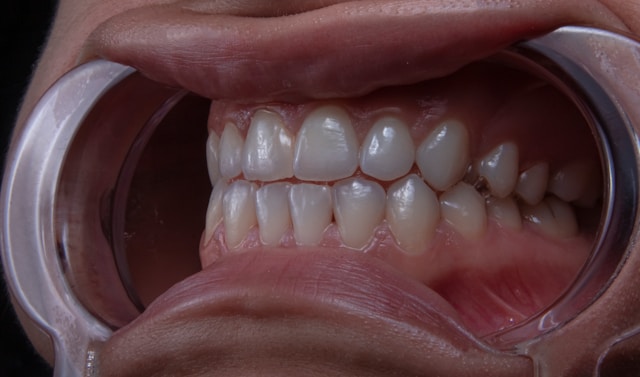

After a TMJ education session with diving instructors at Bali Diving, the conversation revealed something interesting: many instructors had encountered students experiencing tooth pain, ear discomfort, dizziness, and difficulty equalizing underwater — but had never considered that the jaw and TMJ might also be worth looking at.
When we talk about health issues during diving, the ears are usually one of the first things that come to mind.
Difficulty equalizing, ear pain, pressure, or dizziness are familiar complaints for many diving instructors. When these problems persist, referring a student to an ENT specialist is often the natural next step.
But there is another area that is rarely part of the conversation:
the jaw.
This was the topic of a recent TMJ & Diving education session by Lumos Dental Bali with diving instructors at Bali Diving.
So, What Does the Jaw Have to Do with Diving?
The TMJ, or temporomandibular joint, connects the lower jaw to the skull.
During a dive, the jaw and surrounding muscles are constantly working to keep the regulator mouthpiece in place. Holding the jaw in a particular position, biting the mouthpiece for a prolonged period, and continuous muscle contraction can place additional stress on the TMJ.
Research involving professional scuba divers has also found a higher prevalence of certain temporomandibular disorders among divers compared with non-divers.
But what made this education session particularly interesting was not only the research.
It was what the instructors shared afterwards.
“We Actually See Things Like This Quite Often.”
As the discussion opened up, several instructors began sharing experiences they had encountered with their students.
One instructor had a student who experienced tooth pain after descending beyond approximately 8 metres.
Others had encountered students who experienced dizziness or pain around the ear during a dive.
Another interesting situation involved students who could equalize perfectly well on land, but struggled — or were completely unable — to equalize once underwater.
And these were only a few examples.
For many instructors, symptoms involving the ears or equalization naturally led them to think about an ENT-related problem.
What they had not really considered before was that, in some cases, dental conditions, the jaw, or the TMJ may also be worth considering as part of a broader evaluation.
Does This Mean TMJ Causes Equalization Problems?
Not necessarily — and this is an important distinction.
Difficulty equalizing, ear pain, dizziness, and tooth pain during diving can have many different causes.
Experiencing one of these symptoms does not automatically mean that a diver has a TMJ disorder.
Similarly, tooth pain at depth may have a different dental or pressure-related cause and should be properly assessed.
The purpose of TMJ education is not to teach diving instructors to diagnose medical or dental conditions.
Instead, it gives them another perspective:
When a diver repeatedly experiences discomfort, it may be worth looking beyond just one possible cause.
The ears and sinuses are obviously important in diving, but the teeth, jaw muscles, and TMJ may also deserve attention depending on the symptoms.
Why Should Diving Instructors Know About TMJ?
Because instructors are often the first people divers talk to when something feels wrong.
A student might say:
“My jaw feels really tired after diving.”
“Why does my ear hurt?”
“I can equalize on land, but I can’t do it underwater.”
“My tooth suddenly hurts when we go deeper.”
An instructor doesn’t need to know the diagnosis.
But having broader awareness can help them recognize when something shouldn’t simply be ignored and when it may be appropriate to recommend further professional assessment.
This is particularly relevant when a diver experiences recurring jaw pain, jaw locking, difficulty opening the mouth, painful clicking, or symptoms that repeatedly appear after diving.
A Small Addition to Diver Education
One thing became clear from our discussion:
jaw health awareness could easily become a small part of diver education.
It doesn’t require a long medical lecture.
During training, instructors can simply remind students not to bite the regulator harder than necessary, to keep the jaw as relaxed as possible, and not to ignore recurring jaw discomfort after diving.
Most importantly, students should feel comfortable telling their instructor when something doesn’t feel right.
A simple conversation during certification could help a new diver recognize symptoms much earlier.

Connecting the Diving and Dental Worlds
Our session with Bali Diving started as an education program about TMJ.
But the discussion with the instructors highlighted something bigger.
There are many things happening underwater that diving professionals encounter regularly, but some of them may rarely be discussed from a dental or jaw-health perspective.
That is where collaboration between dental and diving professionals can be valuable.
The goal is not to replace the role of ENT specialists or other healthcare professionals. It is to add another perspective that may otherwise be overlooked.
The more instructors understand about how diving can affect different parts of the body, the better equipped they are to help students recognize when something doesn’t feel normal.
Because when discomfort happens underwater, it may not always be only about the ears.
Sometimes, the teeth and jaw deserve attention too.
Lumos Dental Bali — Working together for your bright smile.